




























































































































































7 Effective Cardio Exercises for Weight Loss: A Beginner-Friendly Guide
Updated On: September 2026
About Us
Author Bio
Editorial Policy
Contact Us
Introduction
Losing weight does not require spending hours in a gym or choosing the hardest workout you can tolerate. For many people, a better approach is to find physical activities that are practical enough to repeat week after week.
That is where effective cardio exercises for weight loss can help.
Walking, cycling, jogging, dancing, and other aerobic activities increase energy expenditure while also supporting cardiovascular fitness. But cardio is only one part of the picture. Your food intake, sleep, strength training, daily movement, and ability to maintain the routine all influence long-term weight management. The CDC’s guidance on physical activity and weight management explains how regular physical activity fits into a broader approach to healthy weight.
Current evidence also gives an important reality check. A systematic review and dose-response meta-analysis of 116 randomized clinical trials involving 6,880 adults with higher weight or obesity found that aerobic exercise was associated with reductions in body weight, waist circumference, and body fat. The researchers also found that the benefits generally increased as weekly exercise time increased. PubMed — Aerobic Exercise and Weight Loss: Systematic Review and Dose-Response Meta-Analysis
That does not mean everyone needs to exercise for 150 minutes immediately.
A person who currently does very little may benefit from starting with short walks and gradually building capacity. The best routine is one that fits your current fitness level, health status, schedule, and preferences.
This guide explains seven practical cardio options, how to choose between them, how much cardio you may need, how to combine cardio with strength training, and several simple strategies that can make a weight-loss routine easier to maintain.
Quick Answer
The most useful cardio exercise for weight loss is not necessarily the one that burns the most calories per minute.
It is usually the activity you can perform safely and consistently while gradually increasing your total activity.
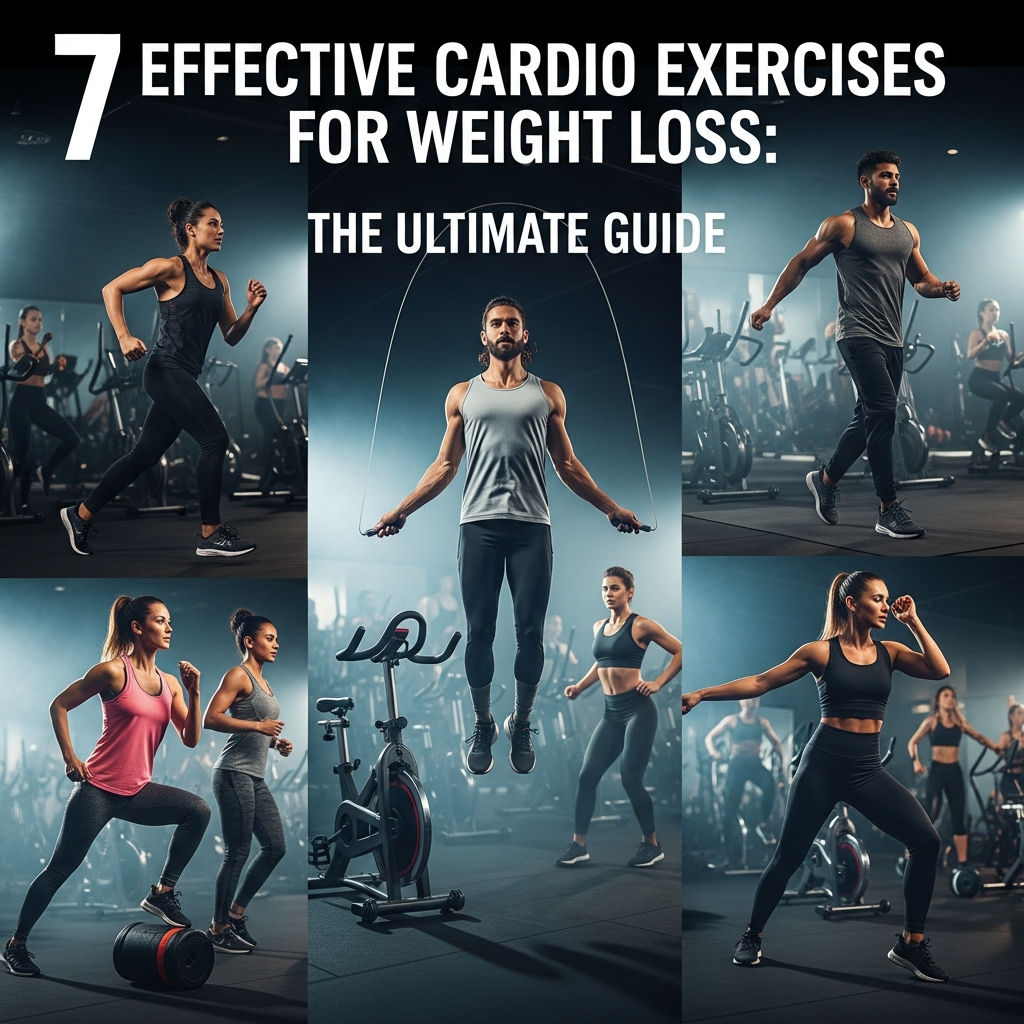
Good options include:
- Brisk walking
- Jogging or running
- Cycling
- Jumping rope
- Dancing
- Stair climbing
- High-intensity interval training, or HIIT
For general health, adults are advised to get at least 150 minutes of moderate-intensity aerobic activity or 75 minutes of vigorous activity each week, together with muscle-strengthening activities on at least two days. The CDC Adult Physical Activity Guidelines also explain that activity can be spread throughout the week rather than completed in one long workout.
For weight loss, however, the amount needed can vary considerably between individuals.
Key Takeaways
- Cardio can support weight loss by increasing energy expenditure.
- Walking is a useful starting point for many beginners.
- Running and jumping rope provide higher-intensity options for people who are ready for them.
- Cycling and other low-impact activities can be useful when reducing joint impact is important.
- HIIT can provide vigorous exercise in a relatively short period, but it is not necessary for everyone.
- Cardio works better as part of a broader weight-management strategy rather than as a substitute for healthy eating.
- Strength training deserves a place alongside aerobic exercise.
- Consistency matters more than choosing the most exhausting workout.
- Your exercise plan should change as your fitness, schedule, and health needs change.
The WHO physical activity recommendations similarly emphasize regular physical activity and recommend that adults include both aerobic activity and muscle-strengthening work.
How Cardio Supports Weight Loss
Weight loss occurs when the body uses more energy than it receives over time.
Physical activity increases the amount of energy your body uses. When combined with an appropriate food intake, this can contribute to the calorie deficit required for weight loss. The CDC’s Physical Activity and Your Weight and Health guidance notes that reducing calorie intake is generally important for weight loss, while regular physical activity is particularly important for health and maintaining weight loss.
This distinction matters.
You do not need to think of cardio as a way to “burn off” every meal. That approach can make exercise feel like punishment.
Instead, think of aerobic exercise as one component of a healthier energy balance.
Cardio also provides benefits that are not captured by the number on a scale. Regular physical activity supports cardiovascular health and contributes to physical and mental well-being. The WHO Physical Activity Fact Sheet summarizes the broad health benefits associated with regular physical activity.
What the latest evidence shows
The dose-response meta-analysis mentioned earlier provides particularly useful information for people interested in weight loss.
Across 116 randomized clinical trials, additional weekly aerobic exercise was associated with modest reductions in body weight, waist circumference, and body fat among adults with higher weight or obesity. The analysis also found a generally increasing relationship between exercise duration and improvements in these measures. View the full PubMed evidence
That does not mean you should immediately aim for 300 minutes.
Your starting point matters.
Someone who currently walks for 10 minutes may benefit more from gradually reaching 20 or 30 minutes than from attempting an exhausting five-hour weekly program.
7 Effective Cardio Exercises for Weight Loss
1. Brisk Walking
Walking is one of the easiest ways to introduce aerobic exercise into everyday life.
You do not need a gym membership, complicated equipment, or advanced technique. A comfortable pair of walking shoes and a safe route may be enough.
For beginners, brisk walking can be especially useful because the intensity can be adjusted easily. You can slow down when needed and gradually increase your pace as fitness improves.
The CDC identifies brisk walking as an example of moderate-intensity aerobic activity. CDC Adult Physical Activity Guidelines
How to begin:
- Start with 10–20 minutes if you are currently inactive.
- Gradually increase the duration.
- Choose a pace that makes you breathe faster without making you feel unable to continue.
- Add short periods of faster walking when your fitness improves.
- Use hills or gentle inclines later if they feel comfortable.
People-first idea:
Instead of treating walking as a separate workout, attach it to something you already do.
A short walk after lunch, a walk while talking on the phone, or a walk before dinner can make physical activity easier to repeat.
2. Jogging or Running
Running requires more impact and greater cardiovascular effort than walking, so it is not the right starting point for everyone.
For people who already tolerate brisk walking comfortably, gradual jogging can provide a vigorous form of aerobic exercise.
You do not need to run continuously.
A beginner could alternate:
1 minute jogging + 2 minutes walking
and repeat the pattern several times.
Over time, the walking intervals can become shorter if the body adapts well.
Running can be useful, but faster is not automatically better. Excessive increases in training volume can increase the risk of overuse problems.
A gradual progression is usually more practical than trying to copy an experienced runner’s routine.
3. Cycling
Cycling can provide a strong aerobic workout while allowing you to control the resistance and pace.
You can ride outdoors or use a stationary bicycle at home.
It can also be useful for people who prefer an alternative to repeated running impact.
Beginner approach:
Start with 15–20 minutes at a comfortable pace. As your fitness improves, increase the duration before making every session harder.
You can later introduce intervals such as
- 2 minutes comfortable
- 1 minute faster
- 2 minutes comfortable
- 1 minute faster
Repeat according to your fitness level.
A 2026 systematic review and meta-analysis of exercise added to low-calorie diets found improvements in several cardiometabolic outcomes, with many of the strongest findings involving aerobic exercise. However, the authors rated the overall certainty of evidence as moderate to low. PubMed — 2026 Exercise Plus Diet Systematic Review and Meta-Analysis
These findings support exercise as part of a broader weight-management approach rather than proving that cycling, or any other single exercise, is universally superior.
4. Jumping Rope
Jumping rope is a vigorous option that requires very little equipment.
It can raise your heart rate quickly, but that also means beginners should avoid starting with long continuous sessions.
Try short intervals instead.
For example:
20 seconds jumping + 40 seconds recovery
Repeat several times.
As your coordination and conditioning improve, you can gradually increase the work period.
Jump rope may not be appropriate for everyone. People with certain joint problems, significant mobility limitations, or a high risk of injury may prefer lower-impact activities.
You do not need to jump rope to lose weight.
It is simply one option.
5. Dancing
Dancing is often overlooked when people discuss structured cardio.
That is unfortunate because enjoyment can influence consistency.
You can dance at home, attend a class, follow a suitable video workout, or simply put on music and move.
The intensity can range from gentle movement to vigorous aerobic exercise.
Try creating a 20-minute playlist and keep moving for most of the session.
You can make the routine more interesting by alternating faster songs with easier ones.
The WHO recognizes physical activity as movement that can occur during leisure and everyday life rather than only through formal gym workouts. WHO Physical Activity Fact Sheet
6. Stair Climbing
Stair climbing is a practical way to increase cardiovascular effort without needing special equipment.
However, stairs can be demanding.
Beginners should start slowly and use a handrail when appropriate.
A simple starting routine might involve walking up one flight at a comfortable pace, recovering, and repeating according to ability.
Avoid rushing.
The goal is controlled movement, not exhaustion.
People with significant knee, hip, heart, or balance problems should discuss appropriate exercise with a healthcare professional before starting vigorous stair workouts.
7. HIIT
High-intensity interval training alternates periods of harder exercise with recovery.
A simple beginner-friendly format might look like this:
- 30 seconds of faster movement
- 60–90 seconds of easy recovery
- Repeat several times
The exercise could be fast walking, cycling, marching, stationary movements, or another activity appropriate for your fitness level.
HIIT is sometimes marketed as the “best” method for fat loss. That is too simplistic.
A systematic review and network meta-analysis examining exercise modalities for visceral adipose tissue reported reductions across several exercise approaches, including aerobic exercise, resistance training, combined aerobic and resistance training, and HIIT. The findings need to be interpreted alongside differences in study design and exercise prescriptions.
The practical lesson is simple:
You do not have to perform HIIT to make progress.
If you enjoy it and can recover properly, it can be useful. If it makes you dread exercise, another form of cardio may be more sustainable.
Cardio Exercise Comparison
| Exercise | Impact | Intensity options | Equipment | Beginner-friendly |
|---|---|---|---|---|
| Walking | Low | Low to moderate | None | Yes. |
| Jogging | Moderate to high | Moderate to vigorous | Shoes | With progression |
| Cycling | Low | Low to vigorous | Bike | Yes. |
| Jump rope | Higher | Vigorous | Rope | With progression |
| Dancing | Low to moderate | Low to vigorous | Optional | Yes. |
| Stair climbing | Moderate | Moderate to vigorous | Stairs | With caution |
| HIIT | Depends on exercise | Vigorous | Optional | Modified version |
There is no universal winner.
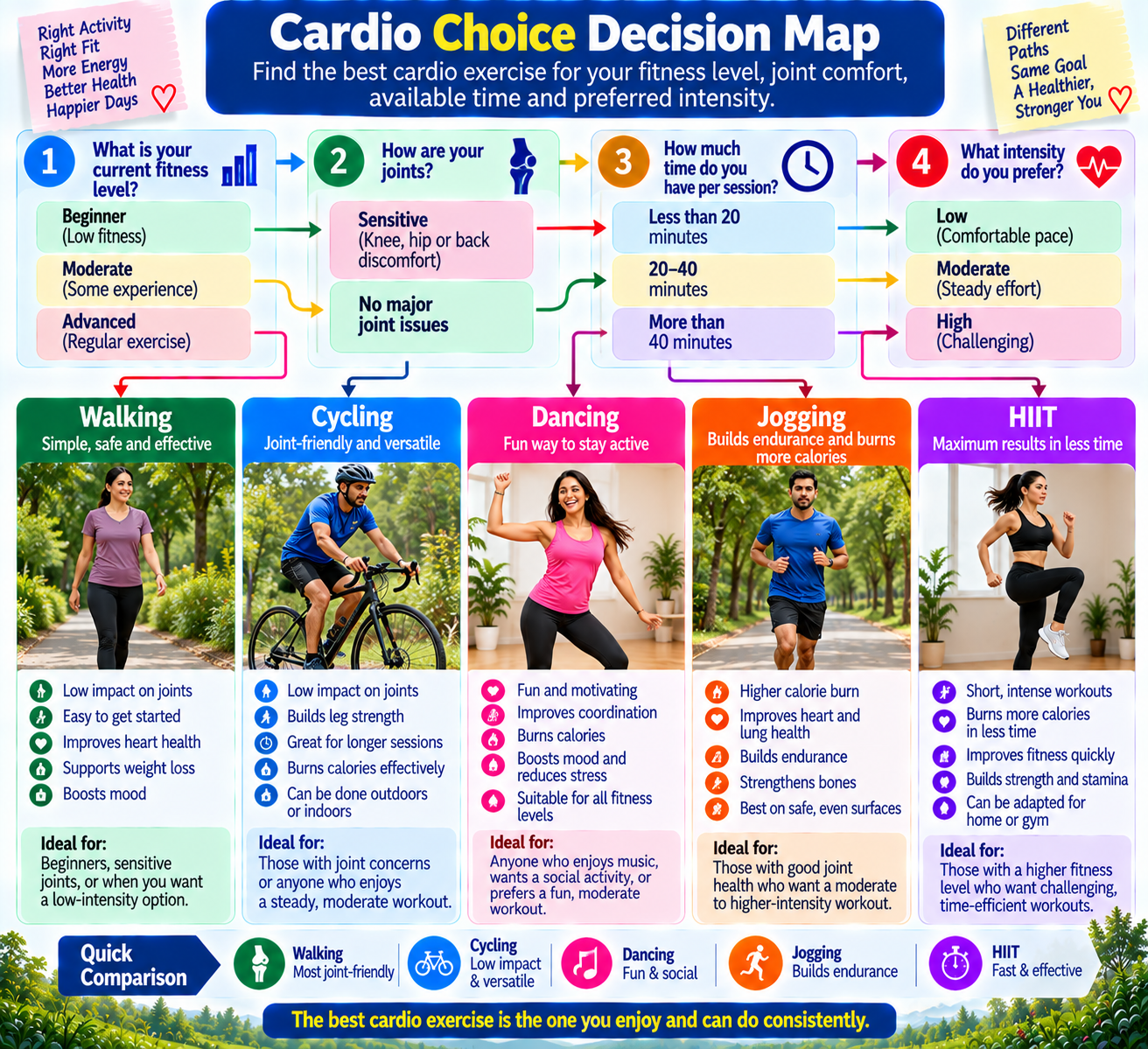
The appropriate choice depends on your fitness level, preferences, schedule, injury history, available equipment, and ability to recover.
How Much Cardio Do You Need for Weight Loss?
This is one of the most common questions.
For general health, adults should aim for at least:
150 minutes of moderate-intensity aerobic activity per week
or
75 minutes of vigorous aerobic activity per week
or an equivalent combination.
Adults should also perform muscle-strengthening activity on at least two days each week. These are the current recommendations from the CDC Adult Physical Activity Guidelines.
The WHO physical activity recommendations similarly recommend 150–300 minutes of moderate activity or 75–150 minutes of vigorous activity each week for adults, together with muscle-strengthening activities on at least two days.
For weight loss, individual needs vary.
The dose-response meta-analysis found that greater amounts of aerobic exercise were generally associated with greater reductions in body weight, waist circumference, and body fat. PubMed — Aerobic Exercise and Weight Loss
Therefore, think of 150 minutes as a useful health guideline rather than a magic weight-loss number.
A Simple Weekly Cardio Plan for Beginners
Here is a practical starting framework.
| Day | Activity | Approximate duration |
|---|---|---|
| Monday | Brisk walking | 25 minutes |
| Tuesday | Cycling or easy walking | 20–30 minutes |
| Wednesday | Recovery walk | 15–20 minutes |
| Thursday | Brisk walking with short, faster intervals | 25 minutes |
| Friday | Rest or gentle movement | — |
| Saturday | Dancing, cycling, or walking | 30 minutes |
| Sunday | Easy walk | 20 minutes |
This provides roughly 135–150 minutes depending on the duration selected.
If you are currently inactive, start below this level and build gradually.
The CDC guidance on adding physical activity as an adult explains that some physical activity is better than none and that activity can be increased gradually.
A Better Strategy: Build a Cardio Menu
One mistake I see frequently is choosing one exercise and repeating it every day.
That can become boring.
It can also place repeated stress on the same tissues.
Instead, create a cardio menu.
For example:
Low-impact options:
Walking, cycling, swimming, or water exercise.
Moderate options:
Brisk walking, steady cycling, and dancing.
Vigorous options:
Running, vigorous cycling, jump rope, or appropriately modified HIIT.
Then choose from the menu according to how you feel that day.
This approach makes the routine more flexible.
Choose the activity based on how your body and schedule feel that day. If your knees are uncomfortable after a previous session, cycling may be more suitable than running, while a brief interval workout can work when time is limited. On days when you feel tired, a comfortable walk may be enough.
The “Minimum Workout” Strategy
One useful approach that is often missing from generic weight-loss articles is having a minimum version of your workout.
Suppose your normal goal is a 30-minute walk.
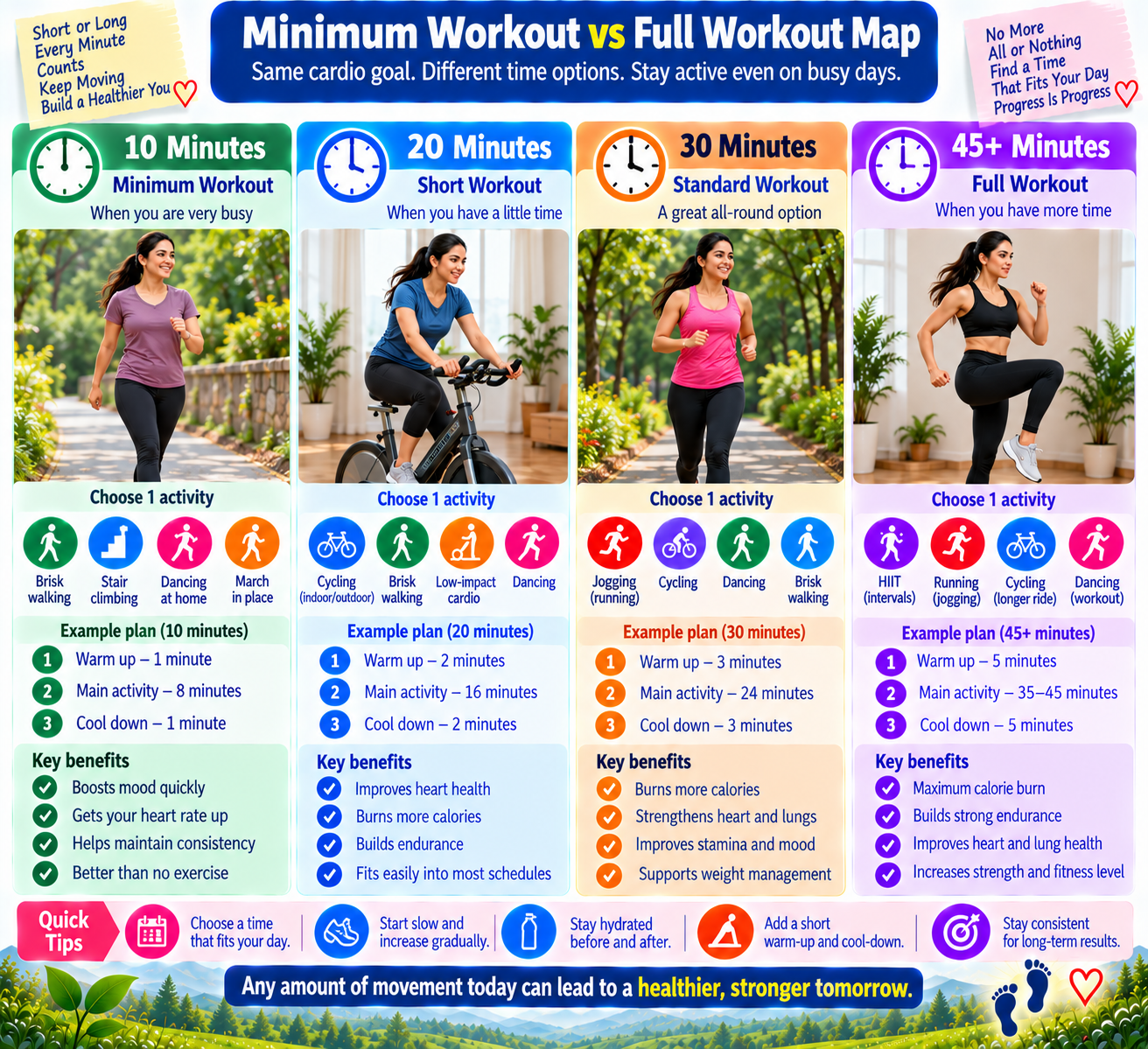
On a busy day, your minimum could be 10 minutes.
That does not mean 10 minutes is equivalent to 30 minutes. It simply prevents an imperfect day from becoming a completely inactive day.
You can walk for:
- 5 minutes before work
- 5 minutes after lunch
- 10 minutes after dinner
Small pieces can add up.
The CDC’s guidance on adding physical activity supports the principle that adding movement to the day can provide health benefits.
Cardio Alone Is Not the Whole Weight-Loss Plan
Cardio is valuable, but it should not be treated as the entire strategy.
Strength training deserves attention too.
A 2025 systematic review and meta-analysis found that resistance exercise during diet-induced weight loss helped protect fat-free mass and increased fat-mass loss compared with dietary restriction alone, although effects on total body mass were not significantly different. PubMed — Resistance Exercise During Dietary Weight Loss
This is important because successful weight management is not simply about making the scale number smaller.
Maintaining muscle and physical function also matters.
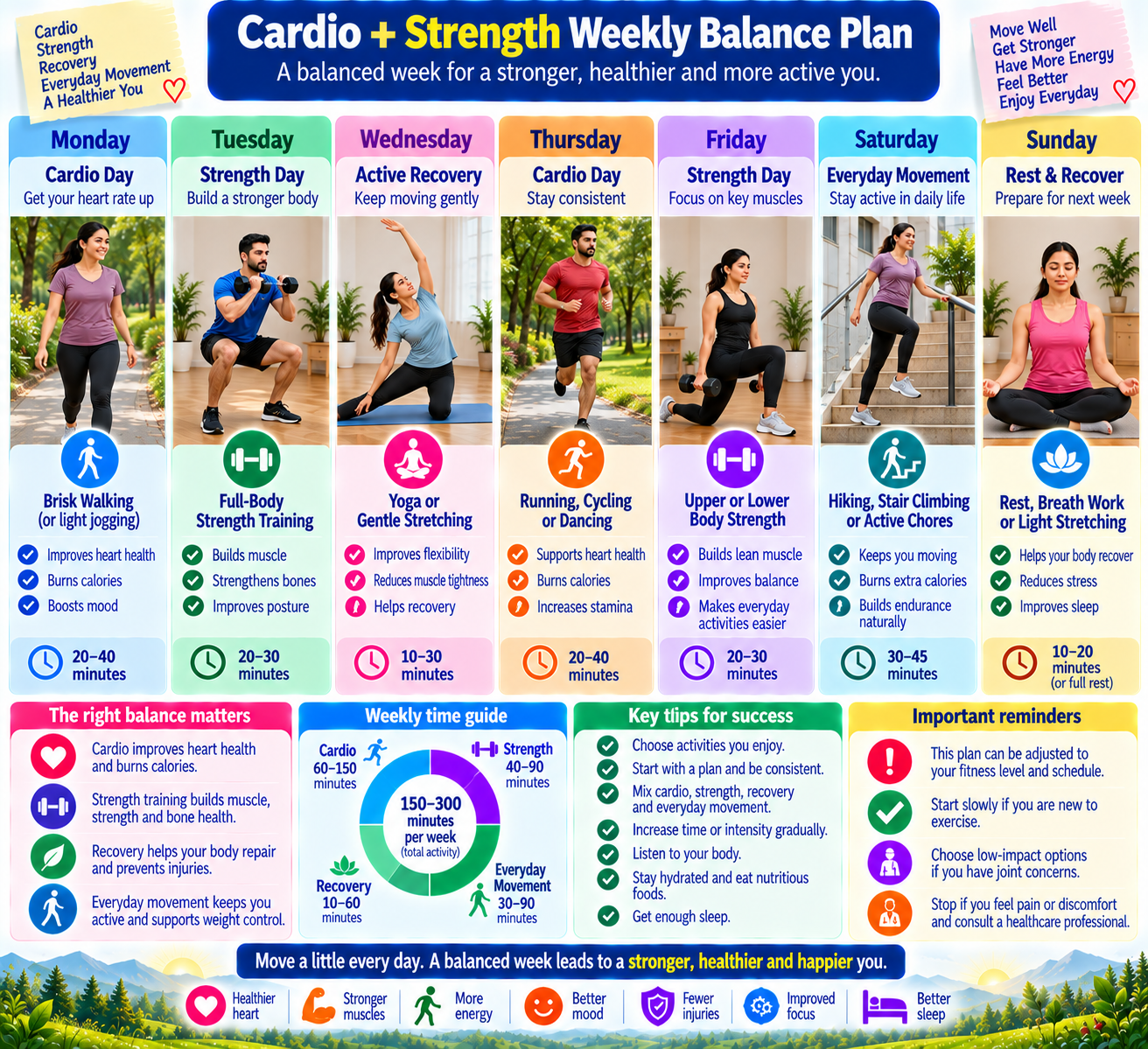
A balanced weekly routine could therefore contain:
- aerobic exercise
- strength training
- ordinary daily movement
- adequate recovery
- balanced nutrition
- sufficient sleep
Cardio and Nutrition: What Actually Matters
You do not need a “fat-burning” drink before cardio.
You also do not need lemon water to make walking more effective.
Instead, focus on habits that support the overall calorie balance and nutritional quality of your diet.
A practical meal might contain:
- a protein source
- vegetables or fruit
- a high-fiber carbohydrate
- a source of healthy fat
You can also reduce calories without making your diet unnecessarily restrictive by paying attention to sugary drinks, oversized portions, and highly processed snack foods.
The goal is not to create a punishment cycle:
eat → exercise excessively → become exhausted → stop → restart
A sustainable pattern is much easier to maintain.
5 People-First Strategies Many Cardio Articles Miss
1. Choose the exercise you can repeat
If you hate running, you do not need to run.
Walking, cycling, and dancing can all provide meaningful physical activity.
The best exercise on paper is not necessarily the best exercise for your lifestyle.
2. Make the first week easier than your ego wants.
Many beginners start with an ambitious program.
They feel motivated for three days.
Then muscle soreness, fatigue, or lack of time takes over.
Start below your maximum.
Your first objective is not to prove how fit you are.
It is to establish a repeatable habit.
3. Use environmental triggers.
Keep walking shoes near the door.
Place your exercise clothes where you can see them.
Schedule your walk at the same time each day.
These small changes reduce the number of decisions required before exercising.
4. Use “exercise snacks.”
A short period of movement can be useful when a full workout is not possible.
Try a few minutes of:
- walking around the house
- climbing stairs
- marching in place
- dancing
- mobility exercises
This should supplement—not replace—the broader activity plan when more exercise is possible.
The CDC’s adding physical activity guidance provides practical guidance on incorporating activity into everyday life.
5. Track consistency instead of obsessing over calories.
You can track:
- workout days
- walking time
- weekly activity minutes
- distance
- perceived effort
- energy levels
The number on a wearable device is an estimate, not a perfect measurement of calories burned.
Common Cardio Mistakes
Starting too hard
A beginner does not need an advanced athlete’s workout.
Build gradually.
Believing more sweat means more fat loss
Sweat mainly reflects your body’s temperature regulation.
It is not a direct measurement of fat loss.
Exercising to “earn” food
This can create an unhealthy relationship with both food and exercise.
Think about your overall health rather than trying to cancel every calorie you eat.
Ignoring strength training
Cardio is important, but resistance exercise can help preserve fat-free mass during weight loss. PubMed — Resistance Exercise During Dietary Weight Loss
Doing the same workout every day
Variety can help reduce boredom and distribute physical stress.
Increasing volume too quickly
Your cardiovascular system may improve faster than your muscles, tendons, and joints adapt.
Give your body time.
Expecting rapid results
Weight can fluctuate from day to day because of hydration, food intake, bowel contents, hormonal changes, and other factors.
Look at trends rather than one morning’s measurement.
When Low-Impact Cardio May Be a Better Choice
Low-impact does not mean ineffective.
Cycling, swimming, water exercise, and walking can provide meaningful aerobic activity while placing less impact on the joints than running or jumping.
This can be useful for people who are returning to exercise after inactivity or who find high-impact exercise uncomfortable.
However, low-impact exercise should still be matched to individual health needs.
People with chronic health conditions or disabilities may need individualized advice about the type and amount of activity that is appropriate. The CDC guidance for people with chronic health conditions and disabilities explains when professional guidance may be appropriate.
How to Know Your Cardio Is Moderate Intensity
You do not always need a heart-rate monitor.
A practical approach is to consider how hard you are working.
During moderate activity, breathing becomes faster and the heart beats more quickly, but you can generally continue the activity without feeling completely exhausted.
During vigorous activity, breathing is substantially harder, and maintaining a conversation becomes more difficult.
The important thing is to avoid treating intensity as a competition.
Your moderate intensity may not be the same as someone else’s.
Latest Research Developments
Research published in recent years has strengthened several important ideas about cardio and weight management.
More aerobic exercise generally produces greater changes.
The systematic review involving 116 randomized trials found a generally increasing association between aerobic exercise duration and reductions in body weight, waist circumference, and body fat. PubMed — Aerobic Exercise and Weight Loss Dose-Response Meta-Analysis
This supports gradual progression rather than the idea that one short workout will transform body composition.
Exercise can complement dietary weight loss.
A 2026 systematic review and meta-analysis of 97 studies found that adding exercise to a low-calorie diet improved several cardiometabolic measures compared with diet alone, although the authors noted moderate-to-low certainty of evidence. PubMed — 2026 Exercise Plus Diet Systematic Review
That reinforces an important point: exercise and nutrition should generally be viewed as complementary rather than competing approaches.
Preserving muscle deserves attention.
Recent evidence also emphasizes what happens to lean tissue during weight loss.
A 2025 systematic review found that resistance exercise during dietary weight loss helped protect fat-free mass while improving fat-mass loss and muscle strength. PubMed — Resistance Exercise During Dietary Weight Loss
This is one reason I would not recommend a cardio-only approach for someone trying to improve body composition.
Aerobic exercise may reduce waist circumference
A meta-analysis of randomized trials found that regular aerobic exercise was associated with reductions in waist circumference among adults with higher weight or obesity. PubMed — Aerobic Exercise and Waist Circumference Meta-Analysis
This is useful because body composition and waist measurements can provide additional information beyond scale weight.
New research is examining exercise intensity more closely.
Recent research continues to investigate whether specific exercise intensities produce different effects on body composition and metabolic health.
The important point for readers is that these studies do not establish one universally superior cardio exercise.
Fitness research is becoming more detailed about intensity, volume, exercise type and individual response. The practical takeaway remains simple: build a sustainable amount of aerobic activity and progress according to your ability.
Personal Experience and Practical Lessons
When I began thinking about cardio as part of weight management, one lesson became clear: starting too aggressively is not necessarily helpful.
A short walk can feel almost too easy at first.
But when it becomes part of your normal day, the habit becomes easier to maintain.
The same principle applies to other forms of cardio.
A person who enjoys cycling may naturally accumulate more weekly activity than someone who forces themselves to run.
That is why I would encourage readers to experiment.
Try walking for one week.
Then try cycling or dancing.
Notice which activity fits your schedule, energy, and physical comfort.
The goal is not to find the hardest exercise.
The goal is to find movement you can continue.
Individual weight-loss experiences should also not be treated as promises. A friend, family member, or colleague may lose a certain amount of weight with a particular routine, but another person’s response can be very different.
A 4-Week Beginner Progression
| Week | Main goal | Example |
|---|---|---|
| Week 1 | Build the habit. | 15–20 minutes, 4 days |
| Week 2 | Add duration. | 20–25 minutes, 4–5 days |
| Week 3 | Add variety. | Walking + cycling/dancing |
| Week 4 | Add selected intervals. | Short faster periods during 2 sessions |
This is only a framework.
If you are very inactive, start more slowly.
If you already exercise regularly, you may need a more advanced plan.
Who Should Be More Careful?
Exercise is beneficial for most people, but certain situations require additional care.
Speak with a healthcare professional before beginning vigorous exercise if you have a medical condition that affects your ability to exercise, significant symptoms during activity, or another reason you have been advised to restrict physical activity.
People with chronic health conditions or disabilities may still be able to exercise, but the type, intensity, and amount may need individual adjustment. The CDC guidance on chronic health conditions and disabilities provides additional information.
Stop exercising and seek appropriate medical attention for concerning symptoms such as severe chest pain, fainting, severe unexplained shortness of breath, or other serious symptoms.
Frequently Asked Questions
What are the most effective cardio exercises for weight loss?
Walking, cycling, jogging, dancing, stair climbing, jumping rope, and HIIT can all contribute to energy expenditure and fitness. The most appropriate choice depends on your fitness, health, preferences, and ability to perform the activity consistently.
Is walking enough for weight loss?
Walking can contribute to weight loss, particularly when it increases your overall activity and works with an appropriate eating pattern. It is also a practical way for beginners to build aerobic fitness.
Is cardio better than strength training for weight loss?
They serve different purposes. Cardio increases aerobic activity and energy expenditure, while resistance exercise can help preserve fat-free mass during dietary weight loss. Current evidence supports including both when appropriate. PubMed — Resistance Exercise During Dietary Weight Loss
How many days a week should I do cardio?
There is no single required number of days. The CDC recommends at least 150 minutes of moderate aerobic activity or 75 minutes of vigorous activity per week for adults, alongside strength training on at least two days. CDC Adult Physical Activity Guidelines
Can I do cardio at home?
Yes. Walking indoors, dancing, stationary cycling, stair climbing, and appropriately modified interval workouts can all be performed at home.
Is HIIT necessary for weight loss?
No. HIIT is one possible training method. You can make meaningful progress with moderate-intensity activities such as brisk walking or cycling.
How quickly will cardio cause weight loss?
There is no reliable timeline that applies to everyone. Weight change depends on food intake, activity, starting body composition, genetics, medications, sleep, and other factors.
Should I exercise every day?
You can be physically active every day, but the intensity does not need to be high every day. Alternating harder sessions with easier movement or recovery days can make a routine easier to maintain.
Can cardio reduce belly fat?
Aerobic exercise can contribute to reductions in overall body fat and waist circumference. A meta-analysis of randomized trials found that regular aerobic exercise produced a modest reduction in waist circumference among adults with higher weight or obesity. PubMed — Aerobic Exercise and Waist Circumference Meta-Analysis
However, you cannot reliably choose exactly where your body loses fat first.
Key Takeaways
Effective cardio exercises for weight loss do not have to be complicated.
Walking can be an excellent starting point.
Cycling provides a low-impact alternative. Running and jump rope offer higher-intensity options for people who are ready for them. Dancing can make exercise more enjoyable, while stair climbing and HIIT provide additional ways to increase intensity.
The bigger picture matters more than any individual exercise.
Aim toward the recommended weekly activity levels gradually. Include strength training. Pay attention to nutrition. Sleep adequately. Increase activity progressively and choose forms of exercise you can realistically continue.
Most importantly, do not judge a workout only by how exhausted you feel afterward.
A routine that you can repeat for months is more useful than an extreme routine that lasts five days.
Author’s Note
I wrote this article with a practical goal: to help readers move away from the idea that weight loss requires extreme workouts.
The research supports the value of regular physical activity, but it also shows why individual results differ.
Exercise should support your health rather than become a punishment for eating.
Start where you are, progress gradually, and choose activities that fit your real life.
Medical Disclaimer
This article provides general educational information and is not a substitute for individualized medical advice, diagnosis, or treatment.
Weight management can be affected by medical conditions, medications, hormonal factors, age, and other individual circumstances.
If you have a medical condition, significant symptoms during exercise, or concerns about starting a new workout program, speak with an appropriately qualified healthcare professional.
Fitness Disclaimer
Exercise carries some risk of injury.
Start at an appropriate level and increase duration or intensity gradually. Use suitable footwear and exercise in a safe environment.
Higher-impact activities such as running, jumping, and vigorous HIIT may not be appropriate for everyone.
Modify or stop an exercise if it causes pain or concerning symptoms.
Research Methodology
This article was updated using current guidance from major public health organizations and recent peer-reviewed research.
The evidence review included current CDC and WHO physical-activity recommendations, systematic reviews, and meta-analyses examining aerobic exercise, weight loss, body composition, waist circumference, and resistance training during dietary weight loss.
Particular attention was given to evidence published or updated through 2026 and to avoiding unsupported calorie-burn promises or claims that one particular cardio exercise is universally superior.
Conclusion
The best effective cardio exercises for weight loss are not necessarily the most intense ones.
Walking, cycling, jogging, dancing, stair climbing, jump rope, and HIIT can all have a place in a well-designed routine. What matters is choosing an activity that matches your current ability and gradually building your weekly activity.
Current evidence shows that aerobic exercise can produce modest reductions in body weight, waist circumference, and body fat, with larger amounts of exercise generally producing greater changes. PubMed — Aerobic Exercise and Weight Loss Dose-Response Meta-Analysis
At the same time, cardio should not be viewed in isolation.
A sustainable weight-management plan combines physical activity with appropriate nutrition and, when suitable, strength training. Recent evidence suggests resistance exercise can also help protect fat-free mass during dietary weight loss. PubMed — Resistance Exercise During Dietary Weight Loss
So instead of asking, “Which cardio burns the most calories?”, ask a more useful question:
“Which form of cardio can I safely perform, enjoy, and continue for the next several months?”
That answer is likely to be much more useful for real-life weight management.
Sources
- WHO—Guidelines on Physical Activity and Sedentary Behavior
- WHO — Physical Activity Fact Sheet
- WHO — Physical Activity Guidelines: Key Messages
- PubMed—Working From Home, Sedentary Behaviour and Physical Activity: 2025 Systematic Review and Meta-Analysis
- PubMed — Relationship Between Working From Home and Physical Behavior: Systematic Review
- PubMed — Working From Home During the COVID-19 Pandemic: Meta-Analysis
Also read this article.
- Active living
- 6 Home Exercises for Overall Fitness and Flexibility: A Comprehensive Guide
- HIIT Workouts for Beginners: How to Start and See Results Fast
- 13 Best Ways To Boost Metabolism With Exercise
- Best 8 Weight Loss Exercises
- How to Burn 1000 Calories Daily










[…] 7 Effective Cardio Exercises for Weight Loss: The Ultimate Guide […]
[…] 7 Effective Cardio Exercises for Weight Loss: The Ultimate Guide […]
[…] 7 Effective Cardio Exercises for Weight Loss: The Ultimate Guide […]
[…] 7 Effective Cardio Exercises for Weight Loss: The Ultimate Guide […]
[…] 7 Effective Cardio Exercises for Weight Loss: The Ultimate Guide […]